

Hey ! Hey !
I think all of you have watched Harry Potter right ? at least once hehe. For those who had watched Harry Potter, I think you guys familiar with the gif above. YES ! IT'S QUIDDITCH GAME. Did you know, Quidditch has become a sport in real life ? But, of course, they will not be flying like in Harry Potter hehe 😆
The objective of Quidditch is to score more points than the opponent.
The information referred from Ninh Ly
QUIDDITCH
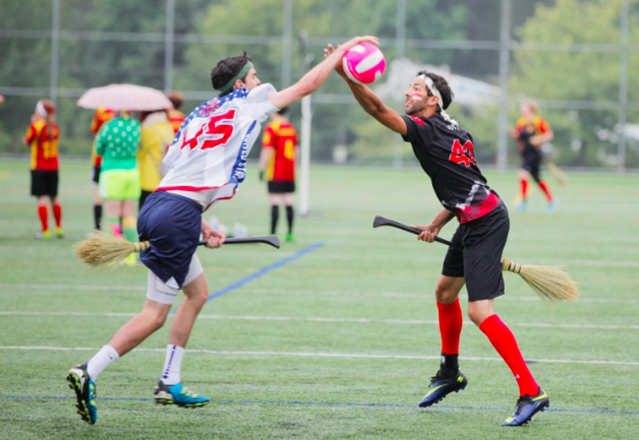
(Source : Google Image)
1. When the players enter the field, they MUST run with a broom between their legs.
2. The chasers on each team will try and get the Quaffle which the ball looks similar with volleyball.
3. To score the point, you must throw the Quaffle through one of the opposite team's hoop.
4. The players are allowed to run with the Quaffle, pass it to teammates or kick it in any direction.
5. If your team successfully throw the ball through the hoop, this will score 10 points.
6. The highest score when the snitch is caught will win.
7. If the game win with a tie (depending on your governing body), an extra period may be added to determine the winner.
TEAM
1. The team must have 7 players with 6 plays in the field.
2. In the team consists of :
> 3 chasers - wearing a white headband
> 2 beaters - wearing a black headband
> 1 keeper - wearing a green headband
> 1 seeker - wearing a yellow headband who isn't active until the 18th minutes
3. A team must have a maximum of 4 players that identify as the same gender. This number increases to 5 once the seekers enter the game.
4. This make Quidditch one of the few sports that are both co-ed and allow the participation of the player who does not identify with the binary gender system.
CHASER
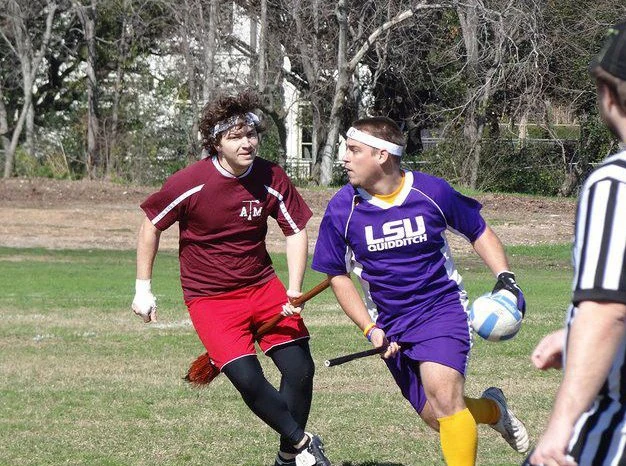
(Source : Google Image)
1. The chasers can throw the Quaffle through any hoop and in any direction.
2. There is only one Quaffle on the field, and its predominant for the chaser to try and score the point.
KEEPER
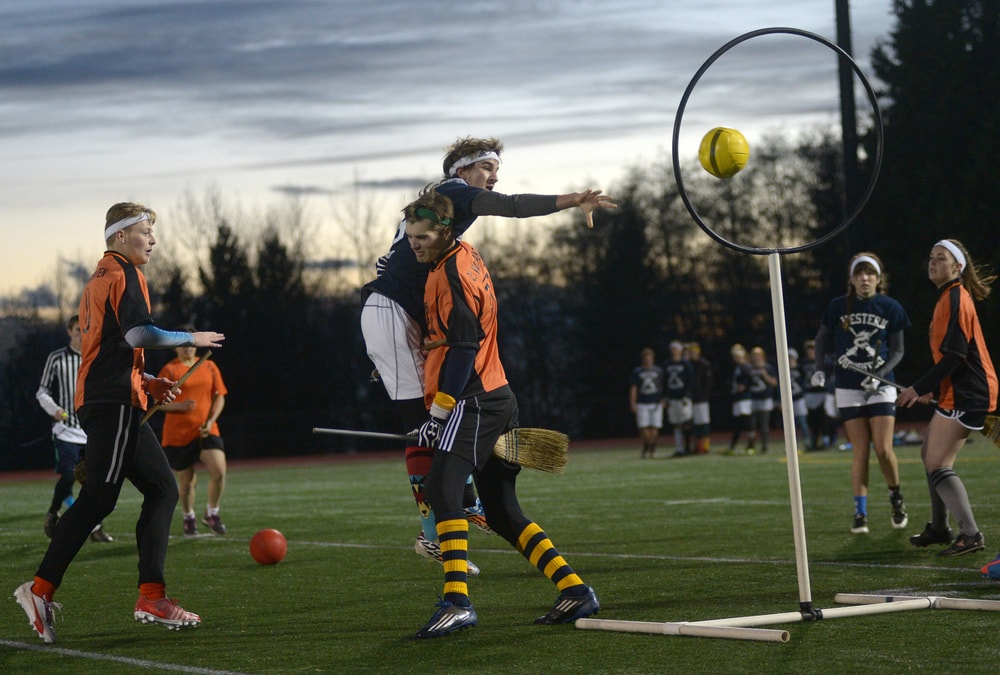
(Source : Google Image)
1. The keeper can also score points just like a chaser but, their main job is to be a defender for their own hoop.
2. The keeper is the only player who is immune from being tackled so long as their standing in their own goal area.
3. The opposing chasers and keepers can try and stop the Quaffle carrier by tackling. Just like in Rugby, the player can grab the ball below the shoulder and pull to the ground.
4. The players also can bump, block, and distract the Quaffle carrier from the front.
BEATER

(Source : Google Image)
1. To knock out opposing players by throwing the Bludger at them.
2. There have 3 Bludgers in play at all times.
3. Dismounting/Knocking out : If the beater hit an opposing player with Bludger, that player must drop any ball their carrying, dismount their broom, run back, and touch their own hoops in order to be eligible to play again.
4. Beaters are not allowed to touch and interfere with the Quaffle in any way shape or form.
5. The keeper and chasers cannot be playing with Bludger.
SNITCH RUNNER

(Source : Google Image)
1. In the 17th minute, a snitch runner (dressed in yellow) is introduced in the game.
2. Snitch runner is neutral and independent from either team.
3. They will be tagged with a snitch - which is a ball in a yellow sock.
4. Their job is to avoid capture for as long as humanly possible because in the 18th minutes the seeker of each team is eligible to play.
THE SEEKER

(Source : Google Image)
1. To catch the snitch, and when one of them has possession of the snitch, this awards their team 30 points, and the game end there.
SUBSTITUTIONS
1. There are unlimited substitutions in Quidditch and a team may have up to 14 substitutes on the bench.
2. To do this, an active player (who hasn't been knocked out) must leave the field on the play before a substitute can come in.
3. Player can also switch roles during play by exchange headband, but they must both be active to do so.
FOUL
1. Foul occurs when the player does things against the rules of the game.
2. Players who commit fouls face different consequences depending on the severity.
3. Back to Hoop : A player must stop and return to their own hoops, as though they have been knocked out.
4. Yellow card : A player must spend one minute in the penalty box, with their team play with short-handed.
5. Red card : A player is ejected from the game. 2 Yellow card = Red Card
6. Some organisation used a Blue card which is similar with a Yellow card. But, two Blue cards does not equal to a Red card.
ADVANTAGE
If the referee thinks that stopping play due to a foul would provide an unfair advantage to the offending team, the referee may call advantage by raising one hand straight into the air. This lets the play resume as normal with no foul being called.
SPEAKING CAPTAIN
A team must design one person to be the captain or speaking captain for the team. They are the only player from a team that is allowed to speak with the referee. If decisions need to be made pertaining to disputed foul, substitution, and which player serves time in the penalty box for multiple infractions, the speaking captain makes the decision.
QUIDDITCH FIELD

(Source : Google Image)
The field was roughly 48 yards long and 33 yards wide with 3 hoops situated at each end of the field.
BLUDGER

A solid-colored dodgeball and there are 3 of them in play at all times.
QUAFFLE

SNITCH

BROOM

HOOPS

I think Quidditch can be played in any physical education classes because it is an interesting game that can be added before started the main syllabus which is a warm-up session for the students. I hope my information here may enhance your knowledge about sports especially unfamiliar sport in Malaysia. Let's share and spread knowledge with others ! 😃
Here I attached a video of Quidditch game :
"US QUIDDITCH WORLD CUP 8 FINALS HIGHLIGHT REEL"
(Source : Youtube)


Your explanations is so amazing! I'm going to try this game soon!! Thank you and please do publish more for your blog.
ReplyDeleteThank you so much for the compliment :)
DeleteI will try my best uploading more information in my blog !
Aaaa I know I know!!! Harry Potter's game right?
ReplyDeleteyupp that's right ! Harry Potter famous game !
Delete